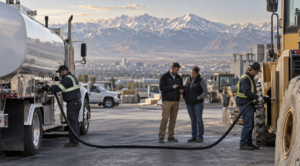
Salt Lake Valley has become one of the Mountain West’s most active business corridors, with construction companies, transportation fleets, manufacturers, equipment operators, logistics firms and service businesses moving people and materials throughout the region every day. As companies grow and job sites become more demanding, even routine operating decisions can have a measurable effect on productivity.
Fuel management is one of those decisions.
For businesses that rely on diesel-powered trucks, generators, heavy equipment and machinery, fueling has traditionally meant sending employees or vehicles to a commercial fuel station. That process may seem insignificant when viewed as a single trip, but repeated stops can consume hours of labor, add unnecessary mileage and create interruptions during the workday.
That is why on-site diesel delivery is becoming an increasingly practical part of business operations throughout Salt Lake Valley. Instead of taking equipment to the fuel, companies can bring the fuel directly to their trucks, machinery, tanks or job sites.
The shift reflects a broader trend in Utah business: companies are looking more closely at operational efficiency and searching for ways to keep employees and equipment focused on productive work.
Fuel Logistics Become Part of the Business Strategy
Diesel is more than a routine operating expense for many companies. It is a resource that directly affects whether equipment runs, trucks leave on schedule and projects continue without interruption.
Construction contractors may operate excavators, loaders, skid steers, generators and other diesel-powered equipment at the same location. Transportation companies can have multiple vehicles that need fuel before beginning routes. Industrial businesses may depend on diesel generators or machinery as part of their daily operations.
In each case, the conventional approach of sending individual vehicles or employees to fueling stations can create operational friction.
Businesses evaluating Diesel Delivery Salt Lake Valley services are increasingly looking at fuel delivery as a way to centralize that process. Rather than having numerous employees make separate fuel stops, a company can arrange for diesel to be delivered directly where it is needed.
That changes fuel from an employee-by-employee responsibility into a coordinated part of business logistics.
The change fits within Utah’s larger reputation as a state focused on business growth and operational efficiency. The Utah Governor’s Office of Economic Opportunity highlights the state’s workforce, transportation connections, business incentives and expanding industries as important parts of Utah’s economic environment.
For companies operating in that environment, eliminating avoidable downtime can become increasingly important as workloads and fleets expand.
Reducing the Hidden Cost of Fueling Vehicles and Equipment
The price displayed on a fuel pump is only part of the actual cost of fueling a commercial operation.
An employee who leaves a job site to purchase diesel is still being paid while traveling to the station. The company may also be paying for mileage, vehicle wear and the lost productive time associated with the trip. Traffic, lines at fuel stations and detours can extend that downtime further.
One fuel stop may have little impact on a business. Dozens of stops across multiple vehicles, employees and workdays can produce a much different result.
On-site delivery changes the calculation by allowing equipment to remain where work is taking place.
For construction companies, this can mean fueling equipment at the job site instead of transporting machinery or using employees to make repeated trips with service vehicles. For fleet operators, it can mean trucks are fueled before drivers begin their scheduled work. For businesses that maintain diesel storage tanks, scheduled deliveries can help maintain an available fuel supply without repeated retail purchases.
These improvements are especially relevant in a growing economy. According to the Utah Department of Workforce Services, construction, professional and business services, education and health services were among the sectors contributing to Utah employment growth during 2026.
Growth creates opportunity, but it also places pressure on companies to use employees, vehicles and equipment efficiently.
Construction Companies Can Keep Equipment on the Job
Few industries illustrate the value of job-site diesel delivery as clearly as construction.
Heavy construction equipment is built to work, not to spend productive hours waiting for fuel. Excavators, loaders, compactors, generators and other machines can consume substantial quantities of diesel over the course of a project.
Bringing fuel directly to the project location can simplify daily operations.
Instead of coordinating multiple fuel runs, supervisors can incorporate fueling into the work schedule. Equipment can remain at the site, operators can stay focused on their assigned tasks, and managers can reduce the number of unproductive vehicle movements associated with obtaining fuel.
That can be particularly useful in Salt Lake Valley, where construction activity is tied to residential development, commercial expansion, transportation infrastructure and population growth.
The broader Utah economy includes industries ranging from construction and manufacturing to technology, mining, tourism and financial services. An overview of the economy of Utah on Wikipedia provides additional background on the diverse industries that contribute to economic activity across the state and along the Wasatch Front.
A diversified regional economy also means diesel demand extends well beyond a single industry.
Fleet Operators Gain More Control Over Daily Scheduling
For transportation and service fleets, the greatest advantage of diesel delivery may be predictability.
A commercial driver stopping for fuel before beginning a route introduces another variable into the workday. The station may be busy. Traffic may be heavier than expected. The driver may need to travel outside the most efficient route.
When several drivers repeat that process, fueling becomes a significant scheduling consideration.
Centralized delivery allows companies to approach fuel more like other inventory and operating resources. Vehicles can potentially be fueled during periods when they would otherwise be parked, helping drivers begin their shifts prepared for work.
That model can benefit trucking companies, delivery services, contractors, utility crews, landscaping operations, waste-management businesses and other organizations maintaining diesel-powered fleets.
The importance of efficient transportation is also connected to Utah’s larger business environment. Data from the U.S. Bureau of Economic Analysis provides ongoing information about state-level economic activity, giving business leaders another way to follow the economic conditions affecting investment, employment and commercial activity.
As business activity expands, companies frequently discover that seemingly small operational improvements become more valuable at scale.
Fuel Delivery Supports Better Resource Planning
Another advantage of diesel delivery is the opportunity to make fuel purchasing more systematic.
Businesses purchasing fuel through individual employee transactions may have to reconcile numerous receipts, card charges and fuel stops. Centralized fuel purchasing can provide a clearer picture of how much fuel is being ordered and where it is being used.
For managers, that can support better budgeting and operational planning.
A company that understands its typical diesel consumption can begin estimating future needs based on upcoming projects, fleet schedules or seasonal workloads. Instead of reacting whenever equipment reaches an empty tank, fuel management becomes something that can be planned alongside labor, materials and equipment.
That approach is consistent with the broader emphasis on data-driven decision-making appearing throughout Utah’s business community. Utah Business regularly reports on economic conditions, employment, transportation, industry growth and the issues affecting companies throughout the state.
Fuel logistics may not receive the same attention as hiring or capital investment, but for diesel-dependent businesses, it can influence both.
Salt Lake Valley’s Geography Makes Efficiency Important
Salt Lake Valley includes a large and interconnected commercial area stretching across communities, industrial districts, construction zones and transportation corridors.
A business may have its office in one city, equipment on a project in another and trucks traveling throughout the valley during the same day. Employees who leave those locations specifically to obtain fuel can add additional travel to already busy schedules.
On-site delivery reduces the need to build unnecessary fuel trips into those movements.
This becomes increasingly valuable when companies are working against deadlines. Construction schedules, service appointments, transportation routes and delivery windows leave little room for avoidable delays.
Fuel delivery cannot eliminate traffic, equipment problems or changing project conditions, but it can remove one recurring task from the workday.
That is a practical distinction. Operational efficiency rarely comes from one dramatic change. It often develops through a series of smaller improvements that reduce wasted time and simplify routine processes.
Reliable Fuel Access Can Help Businesses Prepare for Demand
Commercial fuel requirements can change quickly.
A contractor may add equipment to a project. A transportation company may increase the number of routes it runs. A facility may need additional generator capacity. Seasonal demand may cause fuel consumption to rise during particular periods.
Businesses that have an established delivery process can respond to these changes without completely reorganizing how employees obtain fuel.
Reliable access also matters when businesses are preparing for disruptions. Diesel-powered generators are commonly used for backup power in commercial, industrial and construction environments. Maintaining an appropriate fuel supply can therefore become part of continuity planning as well as daily operations.
Utah companies operate within a regulatory and commercial environment that continues to evolve as the state grows. Businesses seeking information about state commerce issues, consumer regulations and business-related announcements can follow the Utah Department of Commerce for official state information.
Professional fuel management belongs within that same larger conversation about responsible business operations.
Local Diesel Delivery Reflects a Larger Business Trend
The growing interest in diesel delivery is part of a broader change occurring across many industries.
Businesses increasingly outsource supporting activities when doing so allows employees to concentrate on the work that produces revenue. Companies hire specialized providers for payroll, technology, logistics, maintenance, waste removal and numerous other functions.
Fuel delivery follows the same principle.
A construction company earns revenue by completing projects. A trucking company earns revenue by moving freight. A service company earns revenue by completing work for customers. Time spent obtaining fuel is necessary, but the fuel stop itself does not generate revenue.
Bringing diesel directly to the business changes where that necessary activity occurs.
Instead of adapting the workday around the fueling process, companies can adapt the fueling process around the workday.
That distinction becomes more important as businesses add employees, vehicles and equipment. Processes that were manageable for a small operation may become inefficient once a company reaches greater scale.
Utah’s Growth Raises the Value of Operational Efficiency
Utah continues to receive national attention for its business environment and economic performance. The state has attracted companies from multiple industries while experiencing continued development along the Wasatch Front.
That growth produces competition not only for customers, but also for workers, equipment, land and time.
Recent economic reporting has continued to show resilience in Utah’s labor market and private-sector activity. Those conditions make efficiency an increasingly meaningful competitive factor for local businesses. Companies cannot control every operating expense, but they can examine the processes that determine how effectively their employees and equipment are used.
Fuel is one of those processes.
A business that reduces unnecessary trips, coordinates fuel purchases and keeps equipment available for productive work can create efficiencies that accumulate over time.
The significance is not limited to the cost of diesel itself. The larger issue is how fuel fits into the flow of the entire business.
Conclusion
Diesel delivery is changing business operations across Salt Lake Valley because companies are beginning to treat fueling as a logistics decision rather than simply a routine purchase.
For construction contractors, delivery can help keep heavy equipment at the job site. For transportation companies and fleet operators, it can reduce unnecessary driver stops and improve scheduling. For industrial businesses, it can simplify fuel inventory and support continuity planning. Across industries, the common benefit is greater control over a resource that businesses depend on every day.
Salt Lake Valley’s continued commercial growth makes that efficiency increasingly valuable. Companies are managing larger workloads, tighter schedules and more complicated logistics while competing in one of the West’s most active business environments.
On-site diesel delivery represents a straightforward response to those pressures. Fuel arrives where trucks, machinery and equipment are already working, allowing businesses to spend less time pursuing fuel and more time completing the work that drives their operations.
As Utah’s economy continues to develop, practical improvements such as fuel delivery are likely to become an increasingly familiar part of how local companies manage their fleets, equipment and day-to-day productivity.