

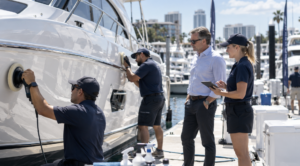
The recreational boating industry has always generated business far beyond the initial sale of a vessel. Every boat that leaves a dealership creates years of additional spending on fuel, storage, insurance, repairs, cleaning, detailing, accessories and ongoing maintenance. As consumers continue investing heavily in outdoor recreation, the products designed to protect those investments are developing into significant businesses of their own.
That makes marine surface care an increasingly interesting part of the broader boating economy. Owners are paying closer attention to faded fiberglass, oxidation, weather exposure and the long-term appearance of their vessels. What was once viewed primarily as routine weekend maintenance is becoming part of a much larger market built around preserving expensive recreational assets.
The numbers behind recreational boating help explain the opportunity. The National Marine Manufacturers Association reported that U.S. recreational marine retail spending reached $54 billion in 2025, including spending on boats, engines, trailers, accessories, fuel, financing, insurance, docking and maintenance. Aftermarket accessories alone accounted for $12.1 billion in spending.
Against that economic backdrop, products such as Boat Polish are moving into a market where appearance, asset protection and long-term ownership costs are increasingly connected.
The Boating Economy Is Much Bigger Than Boat Sales ⚓
The marine industry is easy to underestimate because consumers often see the boat itself as the primary purchase. In reality, buying the vessel is only the beginning of an ongoing economic relationship.
According to the U.S. Bureau of Economic Analysis, boating and fishing generated $38.4 billion in current-dollar value added during 2024, making it the largest conventional outdoor recreation activity in the country. Florida alone accounted for $4.4 billion, followed by California at $3.3 billion and Texas at $3 billion.
The broader outdoor recreation economy was even larger, contributing $696.7 billion to U.S. gross domestic product in 2024. Those figures demonstrate why businesses serving boat owners can occupy valuable positions within the American consumer economy.
This is also why boating-related businesses increasingly deserve attention alongside industries covered by Reuters Business. The recreational marine market supports manufacturers, retailers, service companies, marinas, tourism operations and specialized product brands that depend on continued consumer spending after the original purchase.
Marine maintenance sits directly in the middle of that ecosystem.
Boat Owners Have Strong Financial Reasons to Protect Their Vessels
A recreational vessel can represent a substantial financial investment. Even relatively modest boats may involve significant purchase prices once engines, electronics, trailers and accessories are included. Larger vessels can quickly move into much higher price categories.
That changes the way owners think about cosmetic maintenance.
Sun exposure, saltwater, contaminants, oxidation and ordinary environmental conditions can gradually affect fiberglass and gelcoat surfaces. A finish that once looked glossy can become chalky, dull or faded. For an owner who has invested thousands or tens of thousands of dollars in a vessel, allowing its exterior to deteriorate is rarely attractive.
Surface maintenance therefore serves more than an aesthetic purpose. Keeping a vessel looking cared for can become part of the broader effort to preserve its condition and appearance over years of ownership.
This consumer behavior mirrors a familiar business pattern seen in automobiles, homes and other high-value assets. The larger the original investment becomes, the easier it is for consumers to justify spending on products and services designed to protect it.
Coverage from outlets such as Associated Press Business regularly reflects the enormous role consumer spending plays across industries. Marine care represents a specialized example of that same economic principle, with boat owners creating recurring demand for maintenance products long after purchasing their vessels.
Recurring Maintenance Creates an Attractive Business Model
One of the strongest characteristics of the marine-care market is that maintenance is rarely a one-time event.
Boats remain exposed to environmental conditions throughout their useful lives. Depending on how and where a vessel is stored and used, owners may repeatedly clean, protect and restore exterior surfaces.
That recurring need creates an important distinction between companies selling boats and businesses selling maintenance solutions. A boat manufacturer may make one major sale to a customer and not see another purchase for years. A maintenance-product company has the potential to remain part of that customer’s ownership routine.
Recurring consumer needs are attractive in almost every business sector because they can produce repeat purchases, brand loyalty and word-of-mouth recommendations.
The pattern is familiar to readers of CNBC Business. Businesses built around maintaining existing assets can benefit even when consumers become more cautious about purchasing expensive replacements. Someone who decides not to buy a new boat may still spend money keeping the boat already sitting at the dock looking its best.
That dynamic gives marine-care companies access to both new boat owners and the much larger population of people maintaining existing vessels.
The Used-Boat Market Expands the Opportunity 📈
The size of the pre-owned boating market adds another important layer.
According to 2025 industry figures from the National Marine Manufacturers Association, pre-owned boats represented 79.7 percent of total boat unit sales, while new boats represented 20.3 percent.
That is particularly relevant to surface-care businesses.
A brand-new vessel may leave the showroom with a pristine finish, but an older boat frequently presents a completely different maintenance challenge. Years of exposure can create fading, oxidation and visible deterioration that becomes especially noticeable when a vessel changes ownership.
A buyer entering the used market may therefore become a customer for restoration and maintenance products almost immediately.
Sellers also have an incentive to improve appearance before listing their vessels. A clean, glossy and well-maintained exterior creates a different first impression than a weathered surface. That creates potential demand on both sides of a used-boat transaction.
The resale economy is one reason marine maintenance deserves to be viewed as more than a niche hobby category. It operates inside a large marketplace where millions of dollars continually move between owners, buyers, dealers and service providers.
This intersection of consumer assets and secondary-market commerce is precisely the type of trend that frequently appears within broader reporting from organizations such as BBC Business.
DIY Marine Care Has Created Its Own Consumer Category 🛥️
Another factor contributing to the growth of marine maintenance is the do-it-yourself owner.
Professional boat detailing remains an important business, but many owners perform at least some maintenance themselves. Online product demonstrations, owner groups, boating forums and instructional videos have made specialized maintenance knowledge easier to obtain.
Consumers no longer need to rely exclusively on a marina or professional detailer for every cosmetic issue.
That shift has opened opportunities for companies capable of packaging professional-looking results into products ordinary owners can understand and apply.
The development resembles what has happened in automobile detailing. Consumers who once viewed detailing products as specialty supplies now routinely purchase cleaners, coatings, restoration compounds and finishing products for personal use.
Marine brands can benefit from the same behavior, particularly when their products address a highly visible problem. Oxidation and fading are easy for consumers to recognize. The difference between a dull surface and a restored finish can also be visually dramatic, making marine restoration especially well suited to online demonstrations and before-and-after content.
Business publications such as Forbes Business have long chronicled the ability of specialized consumer brands to build valuable businesses around narrowly defined problems. Marine surface care fits that model particularly well because the customer has an identifiable problem attached to an expensive asset.
Florida Shows the Economic Power of the Marine Market
Few places illustrate the financial importance of boating better than Florida.
The state had the nation’s largest boating and fishing contribution to outdoor recreation value added in 2024 at $4.4 billion, according to the Bureau of Economic Analysis. The National Marine Manufacturers Association also identified Florida as the leading state for recreational marine spending in 2025.
That concentration of boating activity creates an enormous network of related commerce.
Marinas need customers. Dealers need inventory. Boat owners need repairs. Engines require servicing. Vessels require storage. Fiberglass and gelcoat require maintenance. Tourism businesses rely on recreational activity, while coastal communities benefit from spending generated around the water.
A product that occupies even a small portion of this ecosystem can participate in a surprisingly large economic market.
Marine-care companies also benefit from geography. States with warm climates and long boating seasons create extended periods of use and environmental exposure. That can translate into repeated cleaning and restoration needs, particularly in areas where vessels spend significant time outdoors.
Digital Commerce Is Changing How Marine Products Reach Customers
The marine supply business was once heavily dependent on local dealerships, marinas and specialty stores. E-commerce has changed that structure.
A company producing a specialized restoration or maintenance product can now reach boat owners throughout the country without building a nationwide network of physical stores. Search engines, social media, instructional content and online marketplaces allow smaller brands to compete for attention alongside much larger manufacturers.
This creates an unusual opportunity for specialty companies.
A customer searching for a solution to faded fiberglass is not necessarily searching for the biggest corporation. The customer is searching for a product that appears capable of solving a specific problem.
That rewards companies that can clearly demonstrate results, explain their processes and establish credibility with owners.
The transformation is part of the continuing evolution of business communications. The history and role of business journalism documented by Wikipedia shows how commercial developments have become an established category of public interest because individual products often reveal larger changes in consumer behavior, technology and economic activity.
The growth of specialized marine-care brands reflects all three.
Maintenance May Benefit When Consumers Keep Boats Longer
Economic conditions can also create an interesting effect within maintenance industries.
When consumers feel confident about making major purchases, some replace older assets with newer ones. When household budgets become tighter, owners may postpone those purchases and maintain what they already own.
For marine-care companies, either environment can create demand.
New boats create new owners who need cleaning and maintenance supplies. Older boats create restoration needs. Used-boat transactions create another group of buyers interested in improving the appearance of recently acquired vessels.
This gives the marine maintenance sector exposure to multiple stages of the ownership cycle rather than relying solely on new vessel sales.
That is an important business distinction. A company serving only new boat manufacturing may be highly sensitive to annual unit sales. Companies serving the installed base of existing vessels have a much larger potential population of customers.
As Bloomberg Business and other financial publications frequently demonstrate across consumer industries, aftermarket spending can become an important commercial ecosystem of its own. The original product creates the customer base, while years of maintenance generate continuing economic activity.
Visual Results Give Marine-Care Brands a Marketing Advantage 📱
Marine restoration also possesses something many product categories struggle to achieve: an immediately visible result.
Before-and-after photographs can communicate value faster than lengthy advertising copy. A heavily oxidized surface next to a restored glossy finish gives customers a direct illustration of the problem and the potential outcome.
That makes the category naturally compatible with modern digital marketing.
Short-form video, product demonstrations, owner testimonials, educational articles and social media imagery can all show the transformation instead of merely describing it.
For smaller marine businesses, that matters because visual proof can narrow the credibility gap between an independent specialty company and a major national brand.
Customers increasingly conduct research before purchasing products for expensive assets. Companies that explain why deterioration occurs, how restoration works and how surfaces should be maintained can position themselves as sources of expertise rather than simply sellers of another bottle on a shelf.
That educational approach can strengthen customer relationships while expanding organic visibility across search engines and emerging digital discovery platforms.
A Specialized Product Can Participate in a Very Large Economy
The most important business story may be the scale surrounding what appears to be a narrowly specialized product.
Marine polish is not an isolated retail category. It sits inside recreational boating, outdoor recreation, tourism, vessel maintenance, detailing, e-commerce and the enormous aftermarket economy supporting existing boats.
The United States generated $696.7 billion in outdoor recreation value added during 2024, with boating and fishing ranking as the country’s largest conventional outdoor recreational activity by value added. Recreational marine retail spending then reached $54 billion in 2025.
Those figures provide substantial economic context for businesses serving boat owners.
A specialized company does not need to capture the entire boating market to build a meaningful operation. It needs to solve a recurring problem for a fraction of the millions of consumers participating in that market.
That is one of the enduring lessons of specialty commerce. Large industries create smaller industries around themselves, and those supporting markets can eventually become substantial businesses in their own right.
Conclusion
The growing commercial significance of marine surface care reflects a broader change in how consumers treat recreational assets. Boats are expensive purchases, and owners have strong incentives to maintain their appearance, extend their useful life and protect the money invested in them.
At the same time, a large pre-owned market, strong recreational spending, expanding e-commerce and the visual appeal of restoration products are giving specialized marine-care companies new ways to reach customers.
What looks like a simple maintenance category is connected to billions of dollars in economic activity across boating, outdoor recreation and aftermarket consumer spending.
For businesses operating in this space, the opportunity extends far beyond making vessels shine. They are participating in an increasingly sophisticated marine economy built around preserving, maintaining and improving valuable recreational assets long after the original sale.