

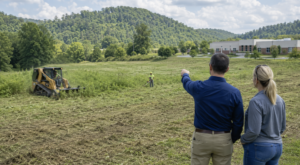
Business property in southern West Virginia rarely fits neatly inside a fence with a small lawn and a parking lot. Commercial parcels, industrial sites, investment properties, utility corridors, undeveloped tracts, storage facilities, construction sites, and land held for future expansion can cover many acres. Once vegetation begins taking over those properties, what first appears to be a landscaping problem can quickly become a business problem.
That is especially true around Beaver and the surrounding Raleigh County area, where wooded acreage, changing elevations, heavy seasonal growth, and large parcels are common. Beaver, West Virginia is a Raleigh County community in the southern part of the state, an area where commercial land often sits close to wooded terrain and undeveloped property.
For a business owner or property manager, keeping acreage under control has less to do with appearance than it does with protecting access, maintaining usable land, preserving visibility, reducing future cleanup expenses, and keeping a property ready for whatever comes next.
That is why Large Acreage Vegetation Management Beaver WV is becoming increasingly relevant to businesses responsible for substantial tracts of land. When vegetation is managed before it becomes overwhelming, property owners retain far more control over how their land can be used.
Large Properties Create Different Maintenance Problems
A five-acre or twenty-acre commercial property cannot be maintained the same way as the lawn surrounding an office building. Large properties may include steep slopes, access roads, fence lines, drainage areas, vacant sections, wooded edges, equipment yards, utility easements, and land being reserved for future use.
These spaces change quickly when they are neglected.
Brush can close in around roads that were previously easy to travel. Saplings can become established along fence lines. Vines and dense growth can make it difficult to inspect portions of the property. Areas that looked manageable one season can become considerably more difficult to reclaim after another year or two of unchecked growth.
For businesses, that difference matters because maintenance costs rarely remain flat when vegetation is ignored. Small growth becomes mature growth. Light clearing becomes heavy clearing. Easy access becomes restricted access.
A planned vegetation management approach gives property owners an opportunity to address growth while the work is still manageable rather than waiting until a large reclamation project becomes necessary.
Property Access Has Real Business Value
Commercial acreage only has practical value when people can reach the portions of the property that matter.
Employees may need access to equipment. Contractors may need to inspect utilities. Surveyors may need to locate property boundaries. Maintenance crews may need to reach drainage structures, fences, storage areas, or remote buildings. Owners may need to show acreage to buyers, tenants, developers, engineers, or financial partners.
When vegetation becomes dense enough to restrict those activities, the property becomes harder to operate.
Clear access routes also make routine inspections simpler. Problems that remain hidden behind brush often remain unnoticed longer. A damaged fence, drainage issue, erosion problem, unauthorized dumping area, or deteriorating structure is much easier to identify when the surrounding land remains visible.
For a business, maintaining those access points is simply part of maintaining the asset.
The broader business climate in West Virginia makes property readiness especially relevant. The West Virginia Division of Economic Development continues to promote available sites, industrial development, manufacturing, energy, building products, technology, and other areas of investment throughout the state. Land that is accessible and manageable is far easier to evaluate when an opportunity for expansion or development appears.
Vegetation Management Helps Protect Infrastructure
Large commercial properties often contain infrastructure that is easy to overlook from the main building.
That can include drainage ditches, culverts, utility boxes, electrical equipment, pipelines, fencing, gates, private roads, storage areas, retaining structures, signs, and other improvements located away from everyday activity.
Dense vegetation can interfere with inspections and make maintenance more difficult. Trees and woody growth can also establish themselves in places where they eventually become expensive to remove.
Keeping these areas clear gives property owners better visibility and makes it easier to notice changes before they develop into larger problems.
This does not mean stripping a property of useful vegetation. Responsible land management involves controlling growth where it conflicts with access, infrastructure, visibility, or the intended use of the site.
That distinction is important. Well-managed acreage can remain natural while still being functional.
West Virginia Businesses Are Paying Closer Attention to Property Costs
Business leaders throughout the state remain focused on operating expenses, workforce needs, investment, infrastructure, and conditions that affect long-term competitiveness. The West Virginia Chamber of Commerce identified lowering the cost of doing business, improving the workforce pipeline, and strengthening the state’s business environment among its 2026 priorities.
Property maintenance belongs in that same practical conversation.
A business does not need to wait for vegetation to cause a major disruption before treating land management as an operating concern. Preventive maintenance tends to give owners more choices. Emergency cleanup tends to give them fewer.
Consider a commercial tract that may be used for expansion three years from now. Keeping access roads, boundaries, drainage areas, and selected portions of that acreage under control during those three years is usually a very different undertaking from reclaiming the entire property after three years of unrestricted growth.
The same applies to land being marketed for sale.
Potential buyers want to understand what they are looking at. Dense brush can make usable acreage appear inaccessible and make it difficult to appreciate the layout of a property. A maintained site allows roads, open ground, boundaries, terrain, and existing improvements to be seen more clearly.
Appearance Still Matters on Business Property
Vegetation management is primarily practical, but appearance cannot be ignored.
People form opinions about a business before they walk through the door. That includes customers, employees, prospective tenants, neighboring businesses, inspectors, vendors, investors, and potential buyers.
A commercial property surrounded by uncontrolled brush can give the impression that parts of the site are unused or forgotten. A maintained property communicates something different. It shows that the acreage has a purpose and that someone is paying attention to it.
This becomes especially noticeable along entrances, frontage areas, internal roads, fence lines, and locations visible from neighboring properties.
West Virginia business coverage regularly reflects the connection between investment, infrastructure, development, and the communities where businesses operate. WV News covers economic development, government, infrastructure, agriculture, industry, and business activity throughout the Mountain State. Those stories provide a steady reminder that commercial properties are part of larger local economies rather than isolated pieces of land.
A well-maintained site contributes to that larger picture.
Large Acreage Can Become More Valuable When It Remains Usable
Unused land and unusable land are two very different things.
A company may intentionally leave several acres undeveloped because it wants room for future buildings, additional parking, equipment storage, new operations, or resale. The acreage may have no immediate role in day-to-day operations, yet it still represents part of the company’s property investment.
Allowing that land to become inaccessible makes future decisions more complicated.
Maintaining strategic access through a property allows owners to continue evaluating it. They can see how water moves across the site, monitor trees and brush, inspect boundaries, watch for erosion, and understand which portions remain suitable for future activity.
That flexibility can become valuable when business conditions change.
Economic conditions never stand still. An analysis published by WV MetroNews highlighted both strengths and challenges within West Virginia’s economy, illustrating why businesses continually evaluate costs, opportunities, workforce conditions, taxes, and growth potential.
Land is part of that calculation for companies that own significant acreage.
When growth opportunities appear, owners generally want to act on them rather than begin by figuring out how to reach portions of their own property.
Vegetation Management Can Support Safer Work Areas
Safety around commercial property involves more than what happens inside a building.
Employees, contractors, utility crews, inspectors, and vendors may travel through less-developed sections of a property. Maintaining reasonable visibility around access roads and frequently used areas can make those movements easier.
Overgrowth can hide uneven terrain, debris, fallen limbs, damaged fencing, holes, drainage areas, or other conditions that deserve attention. Clearing appropriate sections of the property makes those conditions easier to see.
Maintained road edges can also improve sightlines around curves and intersections on private property. Open areas around gates allow vehicles to enter and exit without fighting brush. Clear access near equipment and utility structures gives workers space to perform their jobs.
The objective is not cosmetic perfection. It is functional land.
That practical mindset fits the way successful businesses treat other assets. Equipment receives maintenance because replacement is expensive. Buildings receive maintenance because deterioration becomes costly. Vehicles receive maintenance because reliability matters.
Acreage deserves the same consideration.
Beaver Is Connected to a Larger Southern West Virginia Business Region
Beaver does not operate in isolation from the rest of Raleigh County or southern West Virginia. Businesses in the area serve residents and industries throughout Beckley, neighboring communities, and the broader region.
Economic growth, construction, transportation, education, energy, tourism, and commercial development all influence how land is used.
West Virginia University also maintains a strong connection to the state’s business community through the John Chambers College of Business and Economics, which regularly publishes news involving West Virginia business leadership, workforce preparation, entrepreneurship, marketing, economics, and professional development.
Those larger business conversations eventually become local property decisions.
A company expands. A parcel changes ownership. A contractor purchases additional acreage. A storage facility grows. A developer evaluates a site. An industrial operation requires more room. A business prepares unused land for a new purpose.
Properties that have remained accessible and maintained are simply easier to work with when those changes occur.
Waiting Too Long Can Turn Maintenance Into Reclamation
There is an important difference between vegetation management and land reclamation.
Management is ongoing control. Reclamation is what becomes necessary after control has already been lost.
Once brush grows densely across large acreage, the work required to restore the property can increase considerably. Woody vegetation becomes larger. Access disappears. Fallen trees become entangled with new growth. Existing roads become difficult to identify. Property features become harder to locate.
For businesses with extensive acreage, the most practical approach is often to establish priorities rather than attempting to make every acre look identical.
Primary roads may require regular attention. Fence lines may need periodic clearing. Drainage corridors may need inspection access. Areas around structures or utilities may require consistent maintenance. Undeveloped acreage farther from operations may need less frequent work.
That creates a manageable system.
The goal is control rather than constant clearing.
Vegetation Management Should Be Part of Property Planning
Businesses already plan for roofing, paving, utilities, equipment maintenance, insurance, security, snow removal, and building repairs. Large acreage adds another category to that list.
Land management should be scheduled according to how the property is used and how quickly vegetation returns.
Some areas may need attention annually. Others may require periodic clearing every few years. Certain sections may simply need to remain accessible enough for inspection.
The strongest plan comes from understanding the property rather than applying the same treatment everywhere.
Commercial land has working areas, buffer areas, natural areas, access corridors, future development areas, and sections that require very little intervention. Managing those areas according to their purpose helps businesses avoid unnecessary work while keeping the property functional.
That balance is particularly valuable in West Virginia, where wooded terrain and natural vegetation are part of the landscape.
Conclusion: Managed Acreage Is a Business Asset
Large acreage can be an advantage for a Beaver, WV business. It can provide room to expand, protect privacy, create space for equipment or future facilities, support additional operations, or increase the long-term value of a commercial property.
That advantage begins to disappear when the land becomes difficult to access and expensive to recover.
Vegetation management keeps business owners in control of the property they already own. It protects access, improves visibility, supports inspection and maintenance, preserves future options, and helps prevent manageable growth from developing into a much larger project.
For companies responsible for substantial acreage around Beaver and Raleigh County, the conversation has moved well beyond mowing grass. The issue is protecting usable land and keeping commercial property ready for the next opportunity.
In a business environment where owners watch expenses carefully and opportunities can appear quickly, maintaining control of the land beneath the business is becoming a practical part of responsible property management.