

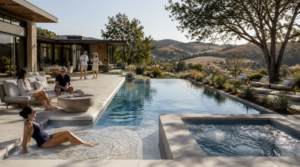
California’s Peninsula Area has long been associated with innovation, architectural ambition, and some of the most desirable real estate in the country. From established neighborhoods near San Mateo and Palo Alto to hillside properties overlooking the Bay, owners increasingly view outdoor space as an important extension of the home. A well-designed pool is no longer treated as an isolated recreational feature. It has become the centerpiece of a private resort environment created for relaxation, entertainment, exercise, and everyday living.
This movement also reflects broader California business trends. Property owners are directing money toward improvements that provide lasting enjoyment, while local contractors, designers, engineers, material suppliers, and maintenance companies benefit from the resulting economic activity. The California Governor’s Office of Business and Economic Development regularly highlights the importance of private investment, innovation, infrastructure, and small-business growth throughout the state. Luxury outdoor construction brings those forces together at the neighborhood level.
Across the Peninsula, resort-style pools are helping turn underused yards into purposeful environments. Thoughtful designs may include integrated spas, sun shelves, outdoor kitchens, shaded seating, fire features, native landscaping, and carefully planned lighting. The result is an outdoor destination that feels connected to the architecture of the property and suited to the owner’s lifestyle. 🌴
California’s Outdoor Lifestyle Is Influencing Property Investment
California has a distinctive relationship with outdoor living. Its climate, architecture, and culture have encouraged generations of homeowners to connect indoor rooms with patios, gardens, courtyards, and pools. That relationship is especially visible in communities where usable land is valuable and property owners want every portion of a lot to serve a clear purpose.
The Peninsula’s generally moderate climate makes outdoor areas useful during much of the year. A pool surrounded by comfortable seating, shelter, lighting, and landscaping can function as a genuine living environment rather than a seasonal feature. Families can use it for weekend recreation, morning exercise, evening meals, and informal gatherings without leaving home.
The region’s identity is also shaped by its place within the San Francisco Peninsula, an area known for diverse communities, major employment centers, high-value residential neighborhoods, and proximity to both the Bay and Pacific Coast. Property improvements here are often expected to complement contemporary architecture, mature landscapes, and the natural contours of the land.
That expectation has moved the market beyond standardized rectangular pools surrounded by plain concrete. Owners are investing in cohesive spaces in which water, stone, plants, light, and architecture work together. This approach treats the backyard as a complete environment and gives the property a stronger sense of identity.
The Backyard Has Become a Private Hospitality Space
One of the clearest California business trends is the blending of residential design with hospitality-inspired amenities. Homeowners often look to boutique hotels and private resorts for ideas, then adapt those ideas to a more personal setting. Infinity-style edges, submerged seating, oversized spas, shallow lounging areas, cabanas, and fire-lit gathering spaces all reflect that influence.
The appeal reaches beyond visual luxury. A private outdoor retreat allows owners to entertain clients, colleagues, relatives, and friends in a relaxed environment. It can also support quiet family time and provide a convenient place to unwind after a demanding day. For professionals working from home or following hybrid schedules, the backyard may serve as a welcome counterbalance to the home office.
This emphasis on private hospitality creates opportunities throughout the local business community. Pool builders coordinate with landscape designers, architects, electricians, plumbers, engineers, lighting specialists, masons, and equipment suppliers. Finished projects may also require ongoing maintenance, water testing, repairs, seasonal landscaping, and technology upgrades. One substantial residential improvement can therefore support a broad network of California businesses.
California’s official recognition of more than 4.3 million small businesses, noted in the state’s 2026 Small Business Month proclamation, provides useful context for this activity. Large outdoor projects frequently depend on the specialized knowledge and workmanship of independently owned local companies.
Design Quality Is Replacing One-Size-Fits-All Construction
Peninsula Area properties differ greatly in elevation, lot size, sun exposure, architecture, privacy, and access. A design that works for a flat suburban yard may be unsuitable for a hillside property or a compact urban lot. This variety has increased demand for customized planning.
Property owners are paying closer attention to proportion, circulation, sightlines, and the relationship between the pool and the house. They want the finished space to look intentional from indoor windows as well as from the yard. Pool dimensions, steps, decking, plantings, and furnishings must work together without crowding the property.
Choosing an experienced Pool Contractor Peninsula Area can help owners approach the project as a complete outdoor transformation rather than a disconnected collection of features. Early coordination is particularly valuable when a design includes complex grading, retaining structures, utility changes, drainage, landscape construction, or multiple entertainment areas.
Material selection has become equally important. Natural stone can create warmth and permanence, while porcelain pavers may offer a clean contemporary appearance. Dark pool interiors can produce a reflective, lagoon-like effect, while lighter finishes may create brighter blue water. Each decision affects the overall character of the space, its maintenance requirements, and its relationship to the home.
Wellness Is Driving Demand for Water-Centered Spaces
The modern resort-style pool is often designed with personal wellness in mind. Swimming provides low-impact movement, while attached spas offer a place for warmth and relaxation. Sun shelves can support quiet lounging, and strategically placed seating can turn the surrounding landscape into a restorative environment.
California’s wellness culture has influenced residential design for decades, but homeowners are now combining several wellness features in one setting. A pool area may include space for yoga, an outdoor shower, a garden path, shaded seating, or a small fitness zone. These additions make the backyard useful for multiple routines instead of limiting it to occasional swimming.
Privacy is another part of the wellness equation. Layered landscaping, trees, screens, walls, and careful positioning can reduce views from neighboring properties while preserving light and openness. Sound from moving water can soften surrounding noise and contribute to a calmer atmosphere.
The investment reflects a broader shift toward improving daily life at home. Resort-style amenities offer immediate personal value because owners can enjoy them regularly. Instead of reserving relaxation for a limited vacation period, they create a setting that supports it throughout the year. 💧
Water Efficiency and Responsible Design Matter
Luxury construction in California increasingly includes practical attention to water use, energy consumption, and long-term maintenance. A beautiful pool must also operate efficiently and fit responsibly within its local environment.
The California State Water Resources Control Board advises residents to check with local water suppliers because cities and districts may adopt measures that differ from statewide requirements. That local dimension is especially important across the Peninsula, where regulations and water-service conditions can vary by community.
Modern pool planning can incorporate covers that reduce evaporation, variable-speed pumps, efficient filtration, automated controls, and systems that monitor operating conditions. Surrounding landscapes can use climate-appropriate plants, efficient irrigation, and thoughtful grouping based on water needs. These choices support a polished resort atmosphere while reducing unnecessary resource use.
Energy efficiency also affects the project’s operating cost. The California Energy Commission provides information about energy policy, efficiency, and clean-energy development throughout the state. Although specific equipment decisions depend on the property and project, owners increasingly consider how pumps, heaters, lighting, and control systems will perform over time.
Responsible design does not require sacrificing comfort or beauty. It encourages careful planning. A pool that is properly sized, well positioned, and paired with efficient equipment can provide a high-end experience without relying on wasteful operation.
Technology Is Making Luxury Pools Easier to Manage
The Peninsula’s connection to technology is naturally reflected in its homes. Owners increasingly expect pool systems to offer the same convenience as other connected household features. Automated controls can allow users to manage temperatures, lighting, water features, schedules, and certain maintenance functions from a central interface.
Convenience matters because a resort-style environment should feel easy to enjoy. Owners are less likely to use a feature regularly if preparing it requires a complicated series of manual adjustments. Integrated controls can simplify daily operation and help ensure that equipment runs according to planned schedules.
Lighting has undergone a similar transformation. Well-placed illumination can define steps, highlight trees, accent stonework, and create a different mood after sunset. Rather than flooding the yard with harsh brightness, layered lighting gives the property depth and makes pathways easier to navigate.
These innovations mirror the entrepreneurial environment documented by the state’s GO-Biz newsroom, where technology, investment, workforce development, and economic expansion remain central themes. In residential construction, innovation is often most effective when it quietly improves comfort, efficiency, and reliability.
High-Value Real Estate Encourages Thoughtful Improvements
Peninsula Area real estate represents a major financial commitment. Owners who plan to remain in their homes often prefer to adapt their properties to changing needs rather than leave a community they value. A backyard renovation can add recreational, social, and aesthetic functions while preserving the location, neighborhood relationships, and daily routines already established.
Broader Bay Area real estate coverage from the San Francisco Chronicle consistently reflects the complexity and significance of property activity across the region. Within that environment, careful improvements can help a home meet contemporary expectations for usable outdoor space.
Resort-style pool projects can be particularly compelling when they solve several property challenges at once. A coordinated plan may replace an aging yard, improve drainage, create more functional circulation, add privacy, modernize utilities, and provide a central gathering place. The pool becomes one part of a larger improvement strategy.
Owners also recognize that design coherence matters. An expensive collection of unrelated amenities may feel less impressive than a restrained plan in which every feature has a purpose. Strong projects respond to the home’s architecture and the land itself, creating a result that appears to belong on the property.
Local Construction Spending Strengthens the Business Community
Residential construction has an economic influence that reaches well beyond the homeowner. Design and construction spending moves through local firms, professional services, equipment distributors, material suppliers, delivery companies, and maintenance providers. Employees and business owners then spend part of that income within their own communities.
California continues to emphasize business growth and private investment through programs covered by the California Jobs First initiative. While a residential pool project operates on a smaller scale than a statewide economic program, it demonstrates the same basic principle: investment creates demand for expertise, labor, products, and supporting services.
Custom outdoor projects are particularly valuable to skilled trades because they cannot be mass-produced in a distant factory and installed without local knowledge. Grading, engineering, permitting, masonry, plumbing, electrical work, landscaping, and finish installation must respond to real conditions at the property. This keeps much of the project activity connected to regional businesses and workers.
Strong demand also encourages local companies to improve their capabilities. Contractors may invest in employee training, design technology, specialized equipment, sustainable materials, and better project-management systems. Those investments can raise the quality of service available throughout the market.
Conclusion
The rise of resort-style pools across California’s Peninsula Area reflects much more than a passing design preference. It represents a larger shift in how property owners think about home, wellness, recreation, hospitality, and long-term investment. The backyard is becoming a carefully planned living environment where architecture, water, landscape, and technology come together.
This trend also has a meaningful business dimension. Each customized project supports designers, builders, skilled tradespeople, suppliers, and service providers throughout the region. It encourages innovation, rewards specialized expertise, and directs private investment into the local economy.
For Peninsula Area owners, the strongest projects balance beauty with function, efficiency, and a clear connection to the property. A thoughtfully designed pool can transform an ordinary yard into a private destination—one that supports everyday enjoyment while reflecting the distinctive lifestyle and entrepreneurial character of California.